14 articles on Policy.
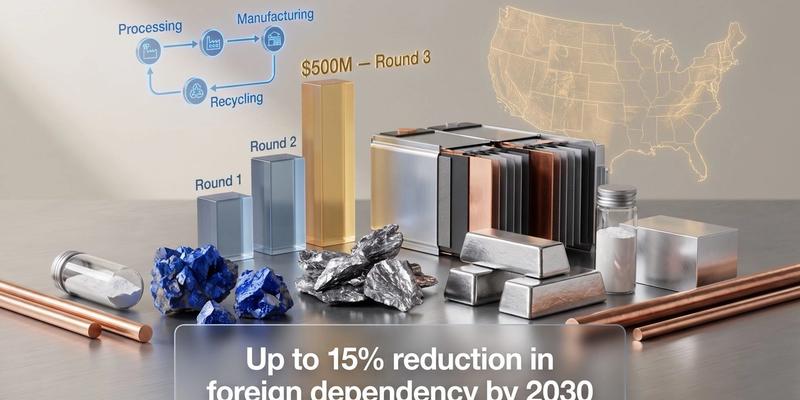
The U.S. Department of Energy has allocated $500 million to strengthen domestic processing and manufacturing of critical battery materials, aiming to reduce foreign supply chain reliance by 15% by 2030.

HydroGraph Clean Power is urging the U.S. to classify graphene as a critical material to reduce reliance on foreign graphite, highlighting its domestic production capability from hydrocarbon gases.
HydroGraph urges US policymakers to classify graphene as a critical material, highlighting its production from domestic hydrocarbon gases instead of imported graphite.
The EU plans a €50 billion Emissions Trading System market for carbon removal, initially excluding lower-tech options like biochar. Future reviews may consider these technologies.

Researchers at the World Resources Institute report that current global CO₂ removal capacity is insufficient to meet the 2030 target of one billion tonnes, with technologies like Direct Air Capture and biochar facing high costs and scalability challenges. This shortfall impacts the advanced carbon materials sector, as these technologies are crucial for achieving net-negative emissions and supporting the sustainable use of biochar and other carbon-based solutions.

The Government of Québec has announced its Plan de gestion intégrée des ressources énergétiques (PGIRE), committing $87 billion over 25 years to boost renewable energy, including forest bioenergy. This investment could significantly advance the production of renewable natural gas and biocarbon, both critical for decarbonizing industries reliant on carbon-based fuels.
St. Louis County, the city of Duluth, and other partners have implemented a green-infrastructure project at Hartley Nature Center to divert and filter stormwater runoff from 117 acres, using biochar among other materials to remediate contaminants. This initiative is significant for advanced carbon materials as it utilizes biochar, a form of carbon, to improve water quality by removing pollutants, benefiting ecosystems connected to Lake Superior.

The Government of Himachal Pradesh, in collaboration with Dr Y.S. Parmar University of Horticulture and Forestry and ProClime Services Private Limited, has launched India's first indigenous biochar project in Hamirpur district, aiming to convert forest biomass into biochar to reduce fire risks and generate carbon credits. This initiative is significant for the advanced carbon materials sector as it transforms waste biomass into biochar, a stable carbon-rich material, thereby contributing to carbon sequestration and offering a sustainable model for forest management and rural livelihoods.

Sustainable Green Team, Ltd. (OTC:SGTM) announced a strategic partnership to expand its biochar production capabilities in the United States. This development is significant for the biochar sector as it aligns with new federal support under the Farm, Food, and National Security Act of 2026.
India has launched the National Critical Mineral Mission with a budget of 343 billion rupees to boost domestic graphite mining and reduce import dependency by 2031. This initiative is crucial for securing a stable supply of graphite, an essential material for electric vehicle batteries and other clean energy technologies, as India aims to meet its ambitious climate goals.

The Morning reports that India's new mineral policy includes guidelines for the treatment and potential sale of effluent generated during the production of reduced graphene oxide. This development could impact the graphene industry by providing a framework for managing waste and potentially creating additional revenue streams from effluent sales.

Chief Minister Sukhvinder Singh Sukhu announced that biochar plants under construction in Hamirpur, Himachal Pradesh, will contribute to earning carbon credits and creating employment. This development is significant for the biochar sector as it highlights the potential of biochar to support sustainable economic growth and carbon management.
Alastair Collier, chief R&D officer of A Healthier Earth, argues in this op-ed that the carbon removal sector's primary obstacle is no longer technological but structural, citing fragmented credit markets, misaligned procurement timelines, and the absence of durable policy frameworks as the core barriers to scale. For the biochar and broader CDR industry, the piece highlights that integrating high-integrity removals into mechanisms like the UK and EU ETS could provide the long-term demand signals and price certainty needed to move projects from pilots to industrial-scale infrastructure.

The Advanced Carbons Council published a position paper in May 2026 arguing that carbon credit financing should be redirected from geological carbon capture and sequestration toward conversion of captured carbon into advanced materials such as graphene, carbon fiber, biochar, and carbon nanotubes. The paper contends that carbon-to-materials conversion projects are commercially self-sustaining without ongoing subsidies, unlike CCS, and deliver compounding lifecycle emissions reductions across sectors including construction, aerospace, agriculture, and energy storage.