19 articles on Graphene in Hydrogen.
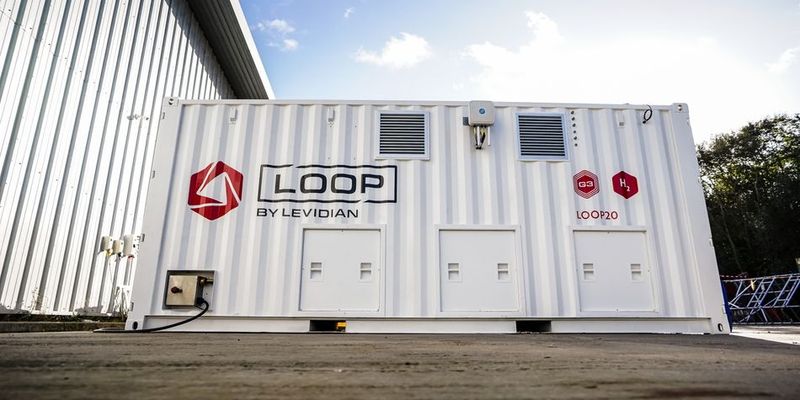
Levidian has launched NanoFlow-S1-20, a graphene additive containing 20 wt.% G3 graphene, designed for easy integration into solvent-based paints using standard mixing equipment.
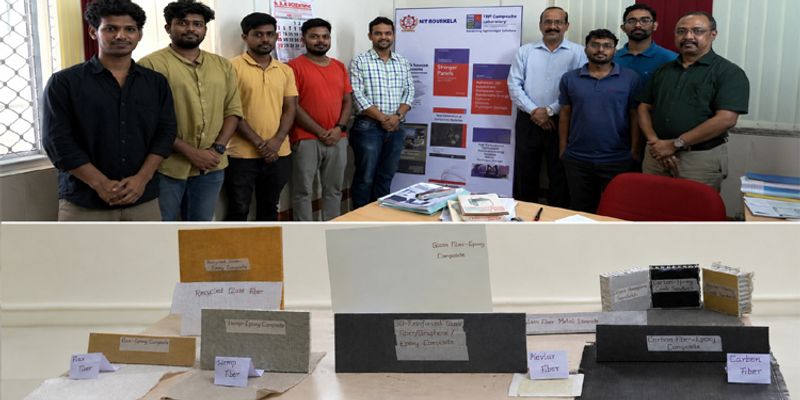
NIT Rourkela has patented a 3D-reinforced composite technology that boosts Fibre-Reinforced Polymer strength and durability, with potential applications in aerospace and automotive industries.

Graphene Manufacturing Group Ltd signed an exclusive MOU with Alstom to develop graphene products for rail HVAC systems.

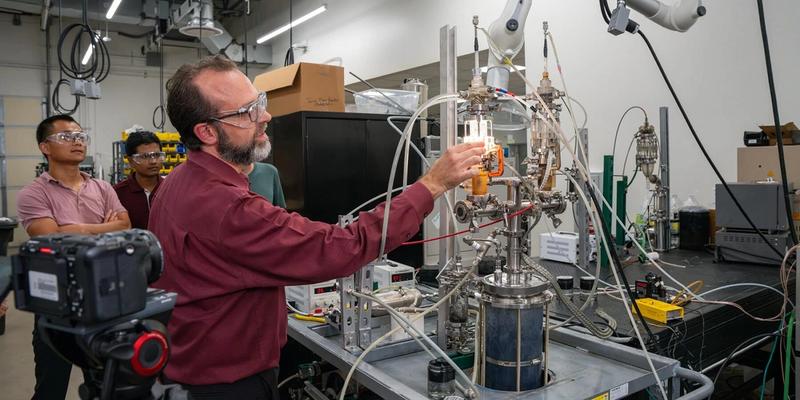
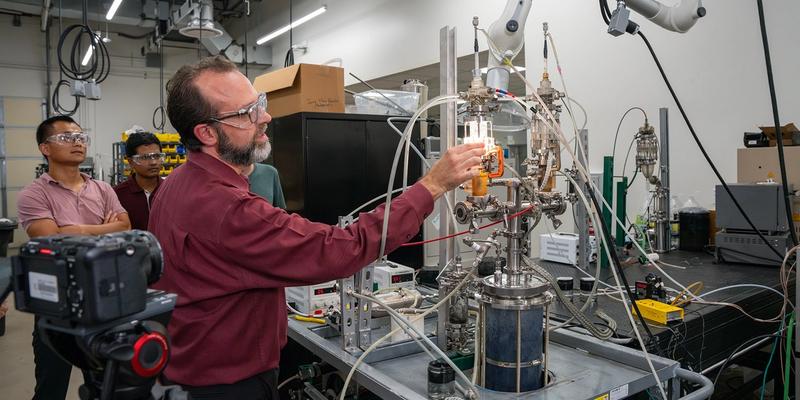
Researchers at Texas A&M University have developed a process to convert methane into graphene oxide using a nonthermal plasma-water interface, potentially reducing production costs.

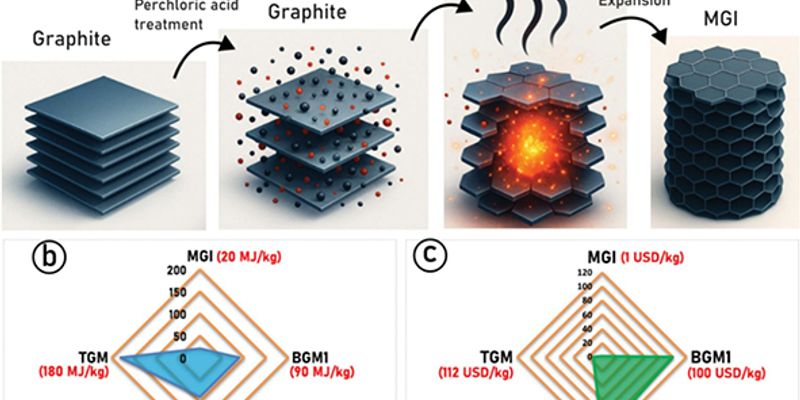
Researchers evaluated four graphene-based materials in carbon fibre/epoxy laminates for hydrogen storage tanks. The study focused on microwave-assisted graphene intermediate (MGI) composites.

Turquoise Group has achieved Verified Graphene Producer® status, confirming its capability to produce 30 tonnes of high-purity few-layer graphene annually at its Brisbane facility. This certification enhances the company's credibility in delivering high-quality graphene, a material crucial for applications in coatings, composites, and energy storage.

Researchers at Texas A&M University found a scalable route to graphene oxide while working on a hydrogen project, a discovery that could cut the cost of a material used in batteries and electronics.

Researchers at Texas A&M University have developed a new method to produce graphene oxide from methane using a plasma-based reactor, which simultaneously generates hydrogen as a byproduct. This scalable approach could reduce reliance on graphite for graphene oxide production, offering a cost-effective alternative for applications in batteries, electronics, and advanced manufacturing.

GTechPlasma, a spin-off from Instituto Superior Técnico in Lisbon, has developed a plasma-produced graphene powder that its researchers estimate could reduce an F-16's radar signature to that of a bird, and has already supplied 260 grams of the material to a Portuguese drone manufacturer. The development is notable for the graphene sector because it demonstrates a tunable, plasma-based production process capable of reaching 40 milligrams per minute, with industrialization underway through partner company Plasmaphene, targeting a market—radar-absorbent coatings—currently restricted to U.S. suppliers.

Tsinghua University Press awarded the 13th annual Nano Research Award to UCLA professor Xiangfeng Duan, recognized for his work on 2D materials, van der Waals heterostructures, and porous graphene architectures, and to Akira Fujishima of the University of Shanghai for Science and Technology, recognized for discovering the Honda–Fujishima Effect and pioneering TiO₂ photocatalysis. Duan's advances in graphene-based energy storage and 2D material synthesis are directly relevant to the carbon materials sector, while Fujishima's photocatalytic coatings have established commercial applications in surface decontamination and industrial wastewater treatment.

Researchers from Cambridge, Harvard, Caltech, and the Max-Planck Institute for Polymer Research published findings in Science Advances showing that nanoconfined water's apparent chemical reactivity is driven by pressure and surface chemistry rather than confinement itself, with hydroxide ions bonding to hexagonal boron nitride walls but not to inert graphene. The work offers a design principle for tailoring water reactivity by selecting confining materials and controlling internal pressures, with direct relevance to graphene-based membranes, carbon electrodes in batteries and fuel cells, and the broader development of two-dimensional carbon and carbon-adjacent materials for electrochemical applications.

Researchers at the University of Córdoba's Plasma Innovation Laboratory developed two methods for depositing graphene onto metal surfaces using microwave plasmas at atmospheric pressure, but found that neither achieved sufficient adhesion between the graphene layer and the metal. The work advances graphene's potential as a corrosion-resistant coating for industrial applications such as fuel cell electrodes, while identifying adhesion as the key technical barrier to overcome.

Researchers from Cambridge, Harvard, Caltech, and the Max-Planck Institute for Polymer Research used machine-learning simulations to study water confined between graphene and hexagonal boron nitride sheets, finding that confinement alone does not alter water's reactivity but that pressure and surface chemistry of the confining material are the controlling factors. For the carbon materials sector, the study establishes that graphene's chemically inert surface does not enhance water dissociation, while reactive surfaces like hBN do, offering a design principle for selecting 2D carbon and non-carbon materials in membranes, fuel cells, and electrochemical systems.

Researchers from Cambridge, Harvard, Caltech, and the Max Planck Institute for Polymer Research published findings in Science Advances showing that nanoconfined water's apparent chemical reactivity is driven by pressure and surface chemistry rather than confinement itself, using machine-learning simulations of water trapped between graphene and hexagonal boron nitride sheets. The work establishes that graphene's chemically inert surface leaves water reactivity unchanged, while reactive surfaces like hBN can actively enhance water dissociation—a design principle relevant to graphene and 2D carbon material applications in membranes, fuel cells, and electrochemical systems.

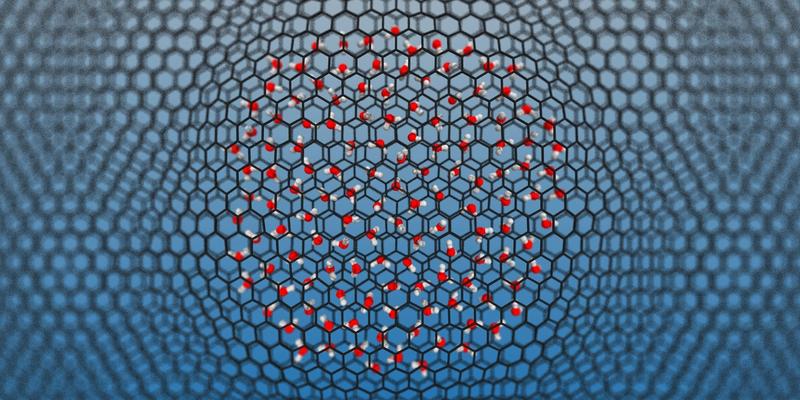
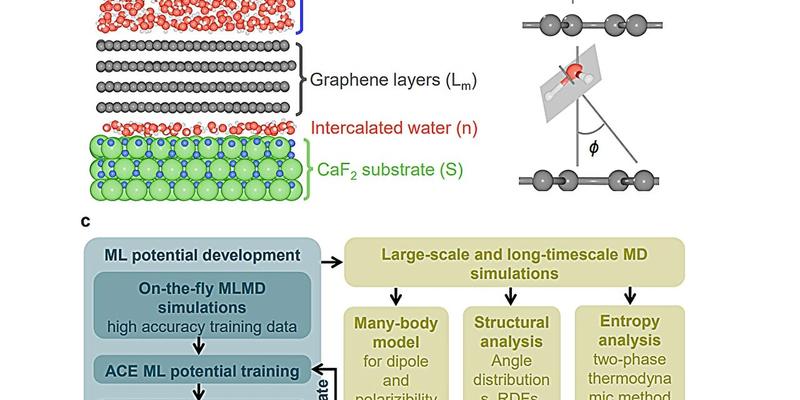
Researchers at the Institute for Basic Science and Korea University used machine-learning interatomic potentials to demonstrate that pristine graphene is intrinsically hydrophobic, with apparent hydrophilic behavior in prior experiments caused by water molecules intercalating beneath monolayer graphene and canceling spectroscopic signals. The findings clarify graphene's true interfacial properties, with direct implications for graphene-based desalination membranes, nanofluidic devices, and fuel cells where unintended water intercalation must be accounted for in design.

Calgary-based Carbonova closed a $25M Series B led by BDC Capital to build a 1,500-tonne-per-year graphene nanotube and hydrogen demonstration plant in Calgary, targeting commissioning in late 2027. The process targets a delivered graphene cost under $35/kg, which, if achieved at scale, could pressure pricing across the carbon nanotube and advanced composites supply chain.

Levidian and Zentek have signed an agreement to explore building a graphene-integrated manufacturing facility in the Middle East, combining Levidian's methane-derived graphene production with Zentek's graphene-enhanced air filters. The deal signals growing regional demand for graphene-enhanced products and positions the Middle East as an emerging hub for graphene manufacturing and deployment across multiple industries.
Levidian and Graphmatech announced a partnership to co-develop graphene-based polymer composites for hydrogen applications, including pipelines and pressure vessels where graphene reduces hydrogen gas leakage by up to 83%. The collaboration combines Levidian's graphene production with Graphmatech's dispersion technology, targeting a growing market for high-performance composites in the hydrogen sector.
Researchers at Yunnan Normal University and Kunming University of Science and Technology used biomass-derived graphene as a catalyst support to cut iridium loading in oxygen-evolution reaction catalysts for PEM electrolysis while maintaining performance.